Circular Motif for Yokes
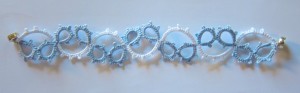
 Been focused mainly on making progress on a new custom piece. It’s for a belly dancer and one of my bracelet designs, but made bigger to fit around her upperarm. I can’t wait to see what it looks like with the rest of her belly dancing costume.
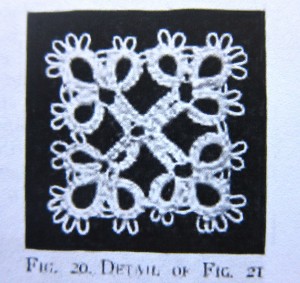
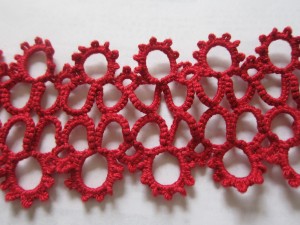
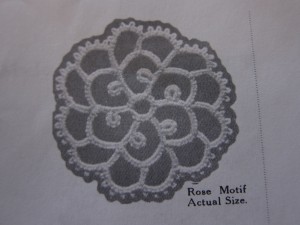
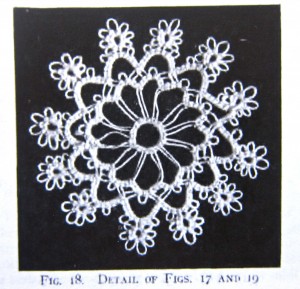
I did take a break from that project today and finished up this awesome little circular motif from pages 5 and 6 of the first Priscilla book. I used some of the blue thread left on my shuttles from the star doily and surprisingly, managed to have almost exactly the right amount left on the shuttle for it. Love when that happens.
I also love the idea of a single join to two separate picots at the same time. It’s something I’d been contemplating, but never actually tried and I think this is the first place I’ve seen it done. I use the point on my shuttle rather than a crochet hook for my joins, but using a crochet hook would probably make this double join a lot easier. It’s not a pattern that I’ll be able to do easily while walking (yes, I tat while walking and hiking) but I really liked the way this motif came out.
The book gives two yoke designs to use this motif for. I haven’t decided if I’m going to do projects that big out of it. Or rather, I doubt I’ll make a yoke, but may find some other large project for it. I’m trying not to start any more large projects right now. I’ve got enough going already so I want to finish a couple others soon. For large Priscilla related projects I just want to focus on finishing the star doily and a baby bonnet from another Priscilla pattern that I’ve been eying and will probably start soon.
ANYWAY. Let’s get on to awesome double-joining pattern for this motif, shall we?
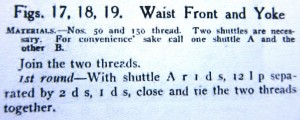
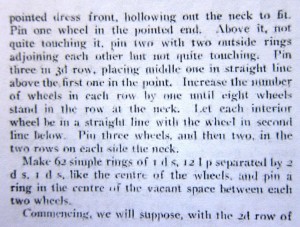
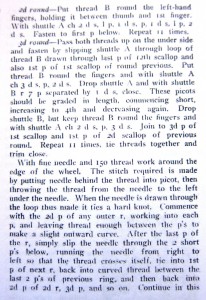 Don’t be intimidated by the length of these directions in the book. Most of them are for the finishing technique and for putting together two different yokes out of this motif.
I didn’t actually try the finishing technique, but I didn’t find it necessary. The reason given for doing it is to make the motif come out 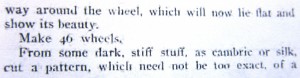
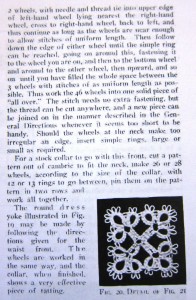 flat and even without blocking. My motif didn’t seem to need anything, but I did make it out of size 10 thread, so that might have made the difference. The book called for size 50.
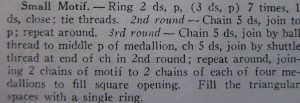
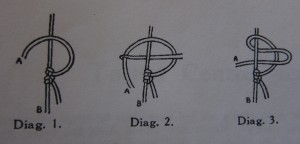
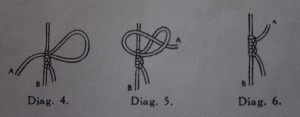
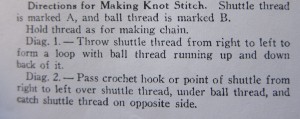
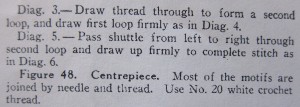
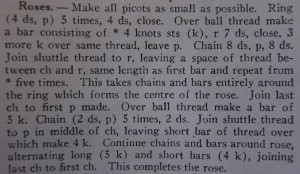
Here’s the instructions for the motif. I’m including the pictures of the instructions for the finishing of the motif, but I didn’t do them on mine. The only difference between the instructions as written and what I did was to climb out of the first ring with a mock picot rather than to cut and tie as they usually have you do.
Wind two shuttles using the CTM.
Round 1
With shuttle 1, R 2(-2)x11Â Picots should be very long.
Round 2
Leave a mock picot,
*Ch 2-1-1-2 leaving the first half of the first stitch unflipped to lock the threads in place.
Shuttle join to next picot on ring.
Repeat from *, working your way around all picots of the center ring. Last join of this round will be into the mock picot.
Join at the same time to both the first picot of the first chain and the last picot of the last chain.
** Ch 3-2
With Shuttle 2 (the same shuttle as made the stitches of the chains) R 1(-1)x7Â Picots should increase in size until the 4th picot and then decrease in size.
Ch 2-3. Shuttle join (Shuttle 1) to TWO picots of the previous round. Both the picot before and the picot after the previous round’s joins to the center ring.
Repeat from **, working your way round the motif. Final chain should be joined to the last picot of the second round.
Hide ends and cut.
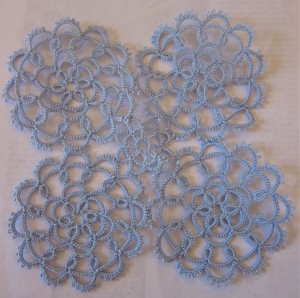
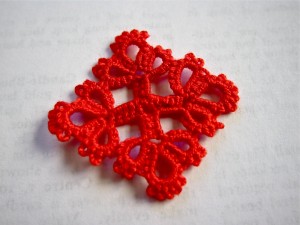
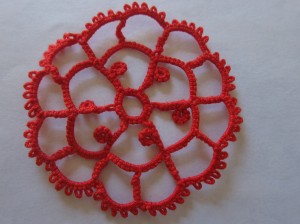
Here’s how mine came out:

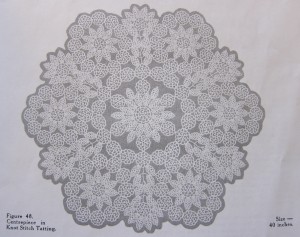
So that makes the basic motif. The instruction continue and want you to use size 150 (I think that’s the size of sewing thread) to weave around the motif. This is suppose to give it shape, I guess. I didn’t do that and not sure that it needed it, but maybe I’ll try it in the future.  The instructions continue and give you directions to make the two yokes below.

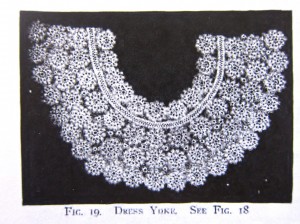
I don’t have any need for yokes. I’m sure I’ll make more of these motifs and I like the way they look sewn together, but don’t know yet what I’ll actually make from them. However, I’d like to make something that’s actually useful. Ideas?