Starting the Star Doily

Today I started with the larger motif that builds into the star doily on page 13 of book 3. I’m a little partial to patterns with lots of chains because they mean you’re less likely to need to add more thread.  🙂 I’d been wanting to try a motif in which some of the rounds were simply chains that joined with the shuttle thread to the previous round. This was a fun little motif and with a split chain/split ring climb out from the inter part to the outer part it meant there was also no tying and cutting until the very end.

I did make a slight change to the very beginning. Instead of joining all the center rings to one large picot from the first ring I made each ring with two small (joining) picots and joined each ring to the previous one.  I don’t like making large picots with multiple joins to them because I never seem to get the size ring.  They’re either too small and bunch up or two big and loose.  Two picots means the center comes out looking a little neater and is a bit stronger to boot.   So where originally the center rings were 7-7 I made them 6-1-6 and they seemed to turn out fine.

Here’s the instructions as I tatted them:
Use CTM, leaving shuttle attached to ball

Round 1

R 6-1-6

CH 10

*R 6+1-6

CH 10 *

Repeat between *’s joining the 6th ring to the first and joining the last chain with a shuttle join to the top of the first ring.

Round 2

Ch 5-6-5, shuttle join to top of next ring, repeat chain around motif joining with a shuttle join at the top of each the next 4 rings.

Last chain is: CH 5-6 split chain of 5 (sorry I don’t know the shorthand for split chains).

Round 3

SR 7/7

CH 10

**R 7+7 (join to next picot on previous ring.)

CH 10**

Repeat between **’s, joining each ring to the next picot of previous round, all the way around. Join last chain with a shuttle join to the top of the first split ring.

Round 4

CH 4-2(x4)-4 ((5 picots separated by 2 stitches)), shuttle join ot the top of next ring, repeat chain around motif joining with a shuttle join at the top of each ring of the previous round.  Continue around motif then tie and cut ends.

You end up with a nice little round motif.  I made this one with size 10 thread.  I was a little disappointed that it turned out just a little bit too small to use by itself as a coaster.  Made from size 3 I think it would be prefect.  AND since it’s much heavier on the chains than rings I think it would tat up easily with size 3 and you probably wouldn’t have to worry about running out of thread on your shuttle.  I am adding it to my list of things to try later.  This list is getting rather long…

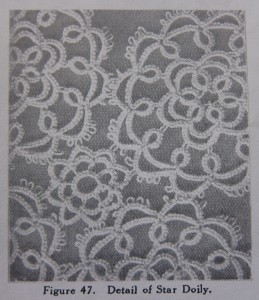
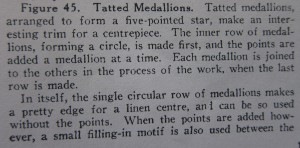
I’m also going to tat up the finished star doily that is described in the book.  There’s a little motif that I’ll also have to learn to connect the larger motifs, but that’s a project for another day.  From just looking at the picture of the finished doily I wasn’t sure how you were supposed to find a cloth that size or cut it to fit, but once I read the directions I saw it’s actually easier than I expected.  You tat and attach all the medallions to each other, sew them onto a large piece of cloth and then cut the cloth away.  Never knew it would be so easy.

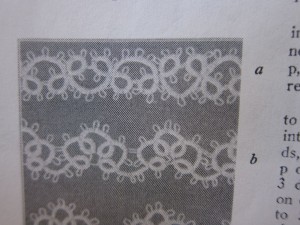
Mom already said she liked the color of this first one so I think I’ll stick with the light blue.  One motif down, 29 to go, (plus the 5 little ones.)  More on this project later, but here’s the doily as it’s shown in the book:

Comments (5)

Finally Friday

Just a quick post today as I had class last night and haven’t done much tatting.  Did photograph and organize a couple pages of Priscilla book #1 so once I do the tatting from those pages I’ll be ready to post about them.  All my shuttles seem to be full so I’ll probably spend the weekend with little projects to finished off what’s on them and start fresh next week.  To that end I made another of the leaf motif bracelets from book #3 that I wrote about in my first post about the Priscilla project.  Seems so long ago.

I wanted to try the pattern in size 10 just so I would know how many repeats would be needed for a bracelet.  It would have been nice to know how much thread was needed too, but of course I didn’t think to measure the amount of thread on my shuttle before I started.  It was EXACTLY the perfect length.  I ended up with just a foot or so left, just the right amount for finishing the last ring.  I’ll have to try it again with a variegated thread so that I don’t need to measure the before and after, I can just count how many repetitions of the variegation it takes to finish.  That’s my lazy way of measuring thread.

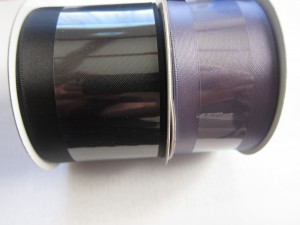
I did make it to Michael’s yesterday to check out what sorts of ribbon they have for the sash/belt.  Of course I forgot to bring the piece with me.  I found the thread I used on the shelf and tried to match the color, but nothing was quite right so I went with black.  Course since I didn’t have the piece with me, I totally got the size wrong.  The black ribbon to the right is about the width of the entire belt, not the loop at the end, but I think it will still work.   Good enough for a proof of concept anyway, and I like the idea of a big ribbon and big bow.   I got the purple to try to make another where the tatting goes directly onto the ribbon.  Haven’t picked out a pattern for that yet, but there’s lots of great edgings in the Priscilla book and I’m sure one of those will work great.

Comments (5)

Tatting Large Rings with Large Thread

Yesterday was a really busy day with work and getting ready for class tonight so I haven’t done much tatting in the last 24 hours, but I wanted to write about something I forgot to include yesterday in my post about the tatted belt. It’s probably not much of a new idea, but I figured it out while during that project and wanted to share it here.

The larger rings were made of 9 picots separated by 3 stitches for a total of 30 stitches in each ring.  Since I was using size 3 thread it meant that each ring took a fairly long length of thread.  I’m not sure how long exactly, but it got really annoying to constantly have to pull more thread through the stitches of the ring.  And as there were more and more stitches on the ring it took more and more pulling.  I could feel wrists tightening up everytime I had to do it and because it was hard to pull the thread through I had to keep stopping to do it.  (I couldn’t just do it with the fingers of my left hand like I can with a smoother thread and smaller ring.)

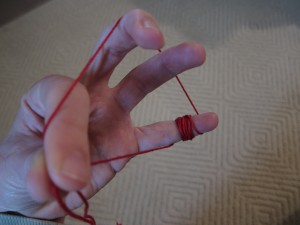
About half way through the project I realized I could wrap the shuttle thread around my pinky like I was making a chain, and then bring it around like a normal ring.  That way as I needed more thread to create the ring I already had it “inside” the ring and just had to unwrap it from my finger.  For the rings in this pattern I found I needed to wrap it around my finger about 10 times to finish the ring without having to pull anymore thread through.

Anyway, that’s all for today.  I just thought it was a handy little trick and hopefully it helps you as well if you ever decide to do a pattern with large rings with size 3 thread.

Comments (3)

Sash Belt (for lack of a better name)

This was one of the rare occasions where I picked a pattern based on a project and not the other way around.  I saw this listing on Etsy of a belt with a large bow in the back and wanted to do something similar in tatting.  (Here’s another cool example from the same designer.)  I wanted a piece of tatting in the front that would tie in the back with a large bow.

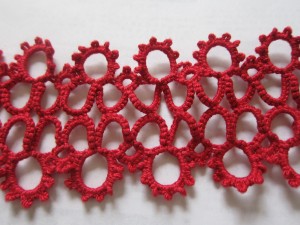
Because a belt is a fairly large piece of tatting I decided to do my proof-of-concept piece in size 3 thread.  That way it would work up faster and if it was a disaster I hadn’t spent too much time on it.  Size 3 thread meant finding a more simple pattern so I flipped through the Pricilla books and found this one on page 5 of the 2nd book.

I figured that in size 3 thread this would work up large enough to make for a bold belt and I picked a nice bright red to give a bit of color to a white skirt I wanted to wear it with. My idea was to tat this pattern for the about 3/4th of the size of my waist and then add red sashes to the ends that would tie in the back.

Here are the instructions as written in the book.  In modern short hand they are:

*Ch 7-7

R 3-3-3-3

Ch 7-7

R 3(-3)x9*

Repeat between *s.  Make a second row that attaches the picots of the chains.

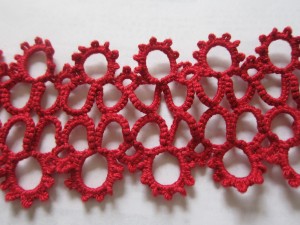
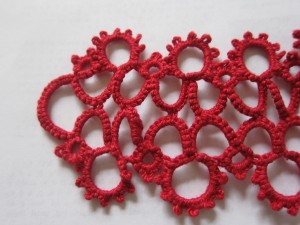
I don’t know who would actually want to start this pattern with a chain, so I started with the small ring and went on from there.  If I were redoing the pattern now I would make the chains shorter.  As you can see in the picture the chains sort of bunched up like there is too much curve in them for the short distance between the rings.  (I wonder if it would help if I didn’t tat the chains as tightly.)

One of the things I learned in Sharon’s tatting design course was that if you have a chain and rings pattern and you want it to stay flat you need to have the number of stitches in the chain equal the number of stitches in the sections of the rings that make up the top part of the negative space created by the rings and chain.  That’s a really complicated way to say it, but maybe if I explain it through this particular pattern.  The first ring has 3 stitches after the picot that will become the join.  The second ring has 3 stitches before the join.  Together that’s 6 stitches.  So if I wanted to do just one row of this pattern and wanted it to be straight I should have chains that connect the rings of only 6 stitches not 14 like this pattern calls for.

I wish I’d stopped and taken a picture before I’d finished adding the second row.  Without the second row the pattern has a tendency to curve in on the ring side.  (Which actually could be a pretty cool effect.  I could see joining picots of the large rings to make the pattern circle around… I’m going to have to try that.)

Anyway, the second row pulls it back and straightens it, but you can still see how it’s bunching in the front.  If I were to do this pattern again I’d probably try 5-5 for the chains to see if that would help.  Without the second row it would still bend but I think that with the second row it would work.  I could try 3-3 which according to the calculations above should keep it flat, but it would also take away some of the height of the pattern and I would want to keep that for the belt. When working the leaf motif yesterday I learned that joining two rings with two joins instead of 1 gives the piece more structure and makes it stiffer.  I wonder if that might work here too with chains of something like 5-4-5 and then 5+4+5.  Just something else to try sometime.

One of the things the book doesn’t mention is how to add on the second row.  I guess they just expect you to tie off the end of the first row and then start the second separately.  I didn’t want to do that because 1) Didn’t want to have to hide more ends than needed and 2) Wanted to create a loop to attach the sash part to later.  Pictured is my solution.  After the last ring of the row I did a chain of 20 unflipped double-stitches before starting up again with the first ring of the 2nd row.

I didn’t flip the stitches of this chain because I wanted it to curve into the rest of the tatting.  This created the loop that I’ll eventually use to attach the sashes.

As a side note here I didn’t start the first row at the end.  That doesn’t really make sense… When I was tatting the second row and was getting back to where I started I kept going and did an extra repeat so the last repeat of the second row made it longer than the first row.  Then I did the unflipped stitches of the end and did what would become the first repeat of the first row.  That way I was making the final knot and hiding the ends about an inch into the piece and not at the end.  I think that might make it a little stronger since it’s the end that’s going to have the most tugging on it when the best is tied.

This is as far as I’ve gotten on this project.  All the tatting is done, but I haven’t figured out how to do the sash part yet.  I’m hoping to find something at Joanns that I won’t have to adapt much because I’m not too fond of sewing.  If you have any ideas, please let me know.  I’ll share the finished piece here when I’m done.

Comments (2)

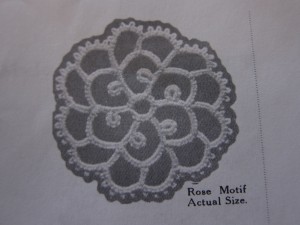
Rose Motif (From Hell)

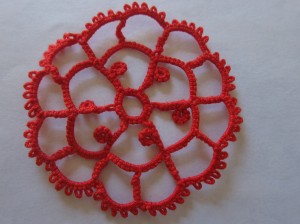
I’m also working on a large piece from the Priscilla books which is an easy pattern but which I’ve chosen to work up in a rather large project.  So I wanted to do a fairly easy pattern for today that wouldn’t take up much time. Since the leaf motif came together so easy on Tuesday I thought I’d do the pretty little rose that goes with it.

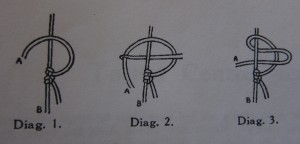
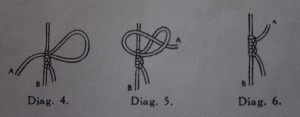
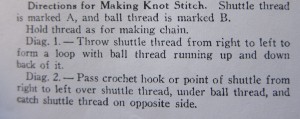
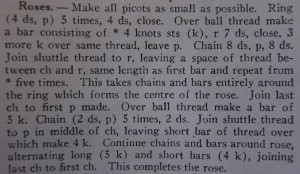
Yeah, that didn’t work out as well as I thought it would.  This unassuming little rose was more complicated than I expected. You see, this rose is the introduction to something Priscilla calls “Knot tatting.”  It’s basically their version of the split chain.  Here’s the pictures and written instructions for it, “A” is your shuttle thread, “B” is the ball thread or the thread you are covering:

I have no way of knowing, but I suspect the usual split chain must not have be around when this book was written in 1924 or else they would have shown that.  This is a cool little knot.  Unlike the split chain which is done in two passes (you have to pull two loops through the space to create the finished knot) this one only takes one pass so it’s a bit easier and faster to make.  The big difference is that the split chain ends up looking like the normal tatting stitch, where as this one doesn’t.  Also, with the split chain the threads that wrap around the core thread fall into place naturally as you do the knot.  With Knot Tatting you have watch and guide them into place a bit more.  It’s slightly easier for it to get unruly.

Each one of those “spokes” on the rose is made up of a series of these knots.  About half way through I was frustrated and sick of them, but by the time I finished I’d gotten a little more comfortable with doing them and I was so pleased with the way it looked I’m sort of ready to try another.  Maybe not right away though.  Here’s the instructions for the rose.

I recommend starting with the Continuous Thread Method (CTM).

R 4(-4)x5

Second round:

Over the ball thread, do 4 knot stitches (I’m calling them ksts in these instructions)

R 7

Ch 3ksts over ball thread leave picot, Ch 8-8

*Join shuttle thread to next picot on center ring leaving space.

Ch 4ksts

R 7

Ch 3ksts, pick up ball thread, leave picot, and Ch 8-8*

Repeat between *’s around the center ring then join to picot at top of first spoke.

Third round:

Ch 5ksts over ball thread, leave picot, Ch 2(-2)x5

**Join shuttle thread to next picot on round 2, leaving space.

Ch 4ksts, pick up ball thread and Ch 2(-2)x5

Join shuttle thread to next picot on round 2, leaving space.

Ch 5ksts, pick up ball thread and Ch 2(-2)x5**

Repeat between **’s around.  You’ll be making 4ksts on top of all picots in chains and 5ksts on top of all picots above spokes.  Join to picot at top of first spoke.

WHEW.  It won’t really make sense until you try it, but hopefully it’s sort of clear once you’ve got thread in your hands.  It took me quite a while to get this little rose finished, but by the time I did I was getting more comfortable with the knot stitch.  In the first round I was getting a bit frustrated with the way it was coming out because I was having trouble keeping it even, so I did a couple spokes in the normal split chain to compare them.  The knot stitch is faster, but a bit harder to keep even. This little rose certainly gives you plenty of practice with it.

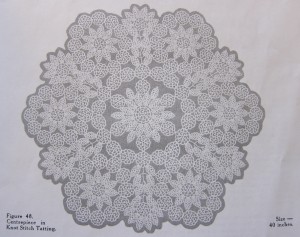
This rose and the leaf motif from Tuesday are part of a large centerpiece.  The final piece has 109 rose motifs.  109! That works out to about 9,000 knot stitches.

I don’t know if I’m up for doing that many.  I might decide that life is just too short to spend my time doing knot stitches, but I do really like the way this rose motif came out and do like the little leaves.  Maybe I’ll just do a couple of smaller pieces with just one rose and the leaves around it.  Here’s the full centerpiece.  Enjoy it now, it might be the only time you see it on my site.  🙂

Comments (18)

Leaf motif

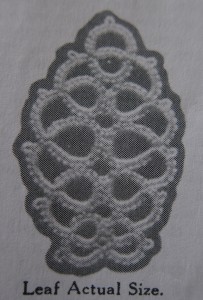
I started work on a large piece that I was going to write up today, but since it still has a fair amount of tatting left I decided to put it aside and work up this quick motif.  This little leaf has been catching my eye every time I flip past it on page 15 of Priscilla Tatting Book #3.  It’s part of the large centerpiece on page 14 and I’ll get to the centerpiece eventually, but today I just wanted to tackle this leaf.  I keep seeing it as a petal and want to try making some flowers out of it eventually.

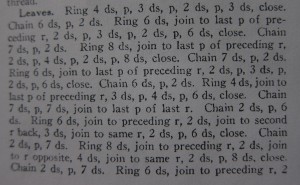
For the size of this simple-looking leaf it has some mightly long directions.  This is the sort of pattern that makes you crave a diagram.  It would be so much easier to follow.  I didn’t even try to start tatting directly from the book.  Before even attempting it, I wrote out the pattern in shorthand so I could have it in front of me while looking at the picture.  It’s still sort of a pain in the butt to follow since every ring is different (well, one half of the leaf is the mirror image of the other, but since there’s joins on the second half that aren’t there on the first half, even in the shorthand version you have to write out each ring and chain separate.

Here it is:

R 4-3-2-3

Ch 6-2

R 6+2-3-2-6

Ch 7-2

R 8+2-4-2-8

Ch 7-2

R 6+2-3-2-6

Ch 6-2

R 4+3-4-6

Ch 7-7+(to last ring, I recommend a shuttle join) 2-6

R 6+(to last ring) 2+ (to opposite ring) 3+ (to second picot on opposite ring) 2-6

Ch 2-7

R 8+(to last ring) 2+ (to opposite ring) 4+ (to second picot on opposite ring) 2-8

Ch 2-7

R 6+(to last ring) 2+ (to opposite ring) 3+ (to second picot on opposite ring) 2-6

Ch 2-6

R 3+ (to last ring) 2+ (to opposite ring) 3+ (to second picot on opposite ring) 4

Ch 6-2 + (to base of first ring made) tie and hide ends

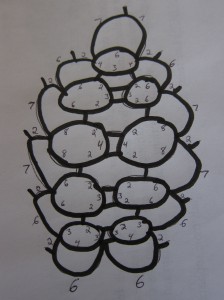
Still annoying to follow, huh?  Fortunately for you, I decided to make a drawing.  Unfortunately for you, I’m not very good at drawing.  Sorry about that.  Hopefully it’s still a little helpful.  (Click on the picture once and it will take you to a window with just the picture where if you click on it again it will zoom in.)

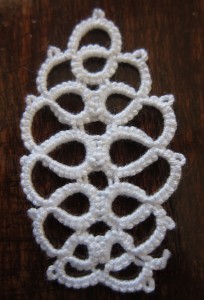
One thing that annoyed me when I finished is that because the last chain has only 2 stitches after the last picot there was no place at the end for me to use the magic thread trick to hide the ends.  You can maybe see in the picture below that I just tied and cut them since this was just a practice round.  When I started tatting it from the pattern I didn’t even take the time to figure out which ring I was starting with, I just did it like a tat-it-and-see and didn’t worry about the end.  Looks like if I want to hide my ends I’m going to have to plan ahead and put in a magic thread in either the first ring or chain.  I think it would probably show less in the ring.  A little annoying since I don’t like to have a magic thread hanging out while I’m tatting.  I’m always worried it will slip out, but I guess that’s what I’ll need to do for this pattern.

I love those little picots on the chains though.  I’m not usually much for decorative picots but those little ones really make a huge difference in leaf.  Gives the edges a more crisp feeling that sort of looks like an oak to me.  I also thought the double joins between the rings was interesting.  This motif seems a little more solid and stiff than most and I think that’s part of the reason why.  Gives the piece a little more structure which is nice.

Well, this is just a small section of the final centerpiece, but since there’s so many of these leaves (and the rose motif that I will tackle another day) I thought I might as well get started.  It will be good for me to have a large project that I can keep coming back to for those days when I want some tatting that will let me zone out and don’t want to work my way through a new pattern.  I’m not actually at the zoning out stage with these leaves though because I still need to figure out how to put them together with the roses for the final piece.  The instructions just say to make all the smaller motifs and “join” them.  I think that they’re using the term “join” generally, and not as a picot join so I guess that just means with a needle and (sewing?) thread.  Seems like there should be a more elegant way to do that, but I’m leaving that for another day.

Comments (3)

First Steps

The first Priscilla book is 33 pages, the second is 43 and the third is 32.  Then there’s also the yoke book from Priscilla which is both tatting and crocheting.  I don’t have it in front of me so I can’t count up how many pages of tatting it has.

It’s sort of hard to tell how many patterns there are on the 100+ pages without going through very carefully and counting.  The books are scanned and the pictures are from the early 1900.  A lot of the detail is lost and the division between patterns is shown just with a slightly large bit of text in the middle of a sea of text.  Ahh, what I wouldn’t do for a diagrammed pattern.

I have messed around with some of the larger projects before and had them sort of end up as a mess.  The patterns an written sometimes don’t match the pictures and even when they do seem to I’ve had trouble getting mine to come out the same or even just flat.  It’s probably in the blocking, but I feel like if you need to block a pattern to make it come out flat then you probably need to change the pattern first.  Blocking is for finishing, but once a piece is tatted it should have basically the right shape.

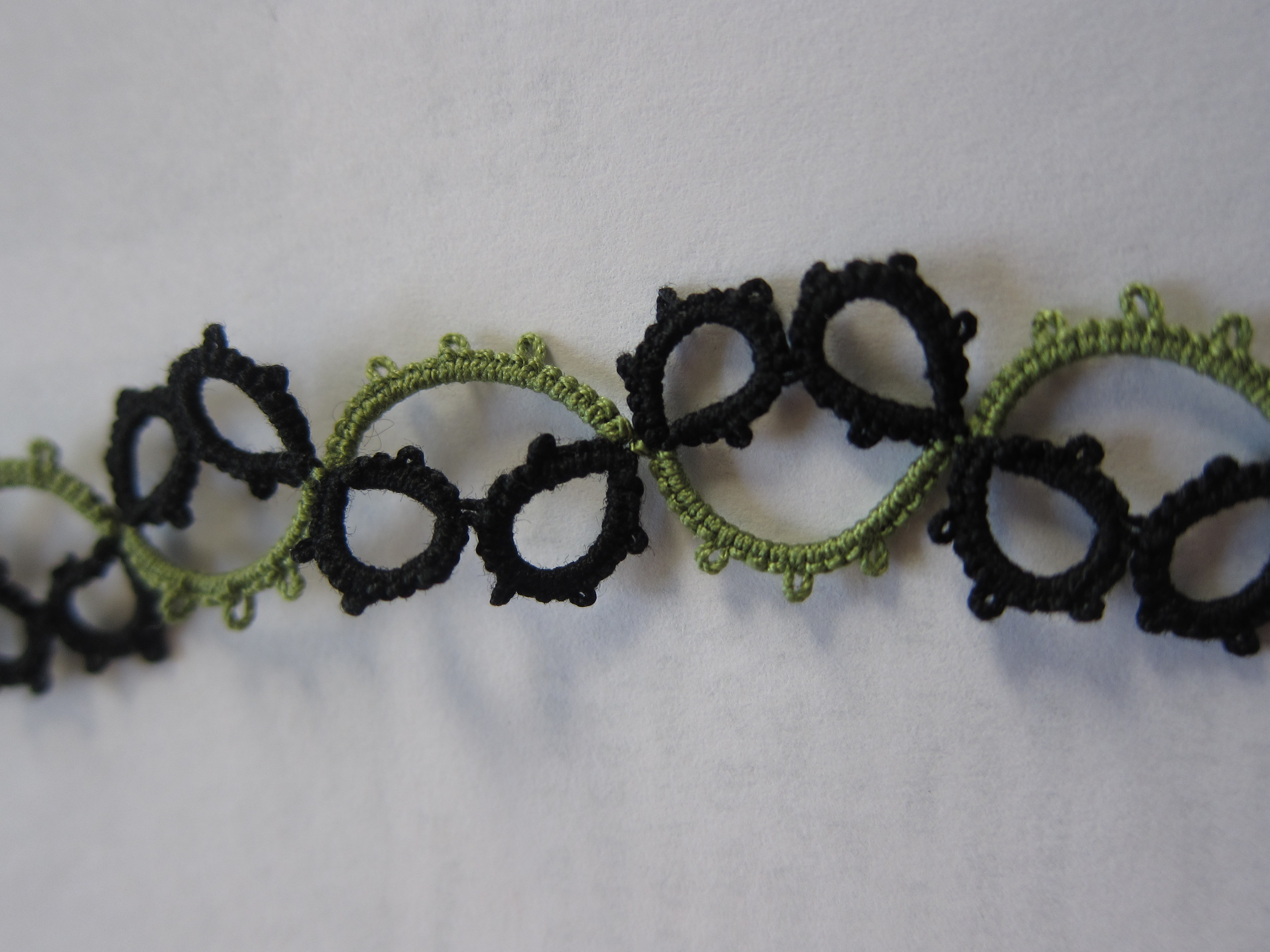
I’m really looking forward to wrestling with those larger patterns, but I wanted to start off with a few of the easier ones first.  It was the edgings on pages 7-10 of the 3rd book that made me first notice the Priscilla books so I’m starting with one on page 8, “Figure 24a” or as I’m calling it, the “Leaf Edging” since I think it looks like leaves on a vine.

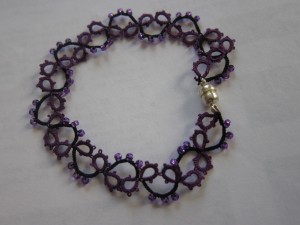
I decided a bracelet of this pattern would be a good way to finish off a bit of black Lizabeth thread in size 20 that I had left on a shuttle.  A magnetic clasp was perfect for it.

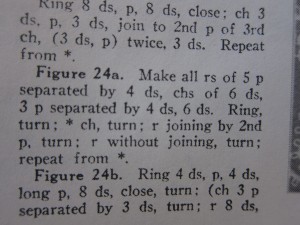
Here’s a picture of the instructions.  Nice and easy, right?  Written out in the more modern short hand they are:

R 4-4-4-4-4-4

Ch 6-4-4-6

R 4-4+4-4-4-4 (join 2nd picot to 4th picot of last ring)

Shoelace trick (my addition, see note below)

Repeat from the beginning, until you’ve reached the desired length then tie and hide ends.

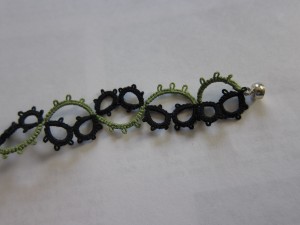
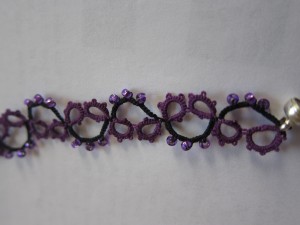
I didn’t think I’d learn much from such a simple looking pattern, but of course, I did.  As written the instructions just say “turn” but I quickly found that just turning and working the second ring would simply leave the shuttle and ball threads crossed once I continued.  In addition to then giving the piece a front and back it also meant the sections would flip around and not stay in place.  This might not matter if you were going to take the finished project and sew it down as an edging, (in fact you might want to have a front and back in that case) but for a bracelet it didn’t work. (See the picture on the right.) a simple shoelace trick before the next ring took care of that and the different sections stay nicely in place now.

I liked this pattern so much I decided to try it with beads with the last bit of purple thread on a shuttle from an earlier project. It’s hard to tell because the purple is so dark, but the rings are purple and the chains are black with purple beads.

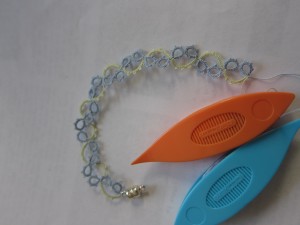
I think this will be a pattern I use a lot.  I especially like it as a quick project for finishing off the last bit of thread on a shuttle by using it as the chain color.  It doesn’t take much to do a bracelet and if I run out on the shuttle I can switch over to a ball to finish it off.  That’s what I’m doing with the third version below.  I had just a little bit left of the green (size 80) left on a shuttle and happened to already have the blue wound on another.  I think I just might be able to finish it with what’s on the shuttle, but if not I’ll switch to the ball.

With that, I’m 1 pattern down and couple hundred (?) left to go.  Stay tuned!

Comments (3)

An Introduction to the Priscilla Project

I’ve been toying around with the idea of a larger tatting project for a while.  I have a habit of reverting back to redoing the same patterns or variations of the same patterns and have been wanting to stretch my tatting skills more but my OCD tendencies are craving a systematic way of doing that.

And thus the idea for the Priscilla Project was born.

As far as I have found, there are 3 full length books and one shorter pamphlet (on yokes) on tatting from the Priscilla Publishing Co. with the first book published in 1909.

I’m not sure why I’ve gravitated to the patterns in the Priscilla books over some of the other great antique tatting patterns out there, but I just love them.  (Especially the third book)  However, actually tatting from them has been both rewarding and frustrating.  The close-up pictures never seem to be of the part of the piece that’s giving me trouble.  The directions are often vague and sometimes wrong.  But the pictures show some incredible pieces and a lot of techniques that I always thought were newer inventions.

As soon as I got my printed copies bound it started feeling like a real project that I could tackle.  Now I have flipped through and drooled over the books enough.  Time now to start tatting.

I have no idea if I’ll eventually end up tatting all the patterns.  The OCDness in me wants to make that as a goal, but my more practical side is reminding me that I’m also a working grad student and that even if I weren’t, working (and likely re-working and re-working again) the patterns would take years.  Plus I’ve got other projects going on in my life (both with and without thread and shuttles).  Who knows?  In a year or two I could get sick of attempting to read the tiny print.

So as I start off I set no goals for this project.  Or rather, for right now, the goal is simply to explore these books more and to document the process as much as my time will allow.

I suspect that a few of the the patterns will leave me baffled, frustrated and confused.  But I can tell just from flipping through the books that it’s also going to be a lot of fun.

If you’re interested in exploring the books with me, print out your own copies of these awesome books.  You can find them online at the Antique Pattern Library, a great resource for all sorts of antique lace patterns of all sorts of techniques. Or if you want a more compact list of just tatting books, check out the InTatters.com selection of antique tatting patterns (These are mostly pulled from the Antique Pattern Library, but this site saves you time by only listing tatting books.)

Enjoy!

Comments (3)

Happy New Year!

2010 went out with a whimper when I got a migraine and went to bed early.  2011 started off much better when I woke up to a clear head and a sale on Etsy.  Yay for 2011! Hopefully both are trends that will continue for the rest of 2011.  I’m celebrating the new year with 20.11% off all bracelets in my Etsy shop as January’s Sale of the Month.  I’ve been listing lots of bracelets lately and still have more to go because I was able to take pictures with my second cousin last week.  My arms are too hairy for pictures, but hers are lovely.  Thanks Mary!

Our family was finally together long enough to open presents so we celebrated Christmas this morning.  I’ve got some new teas to try out so I think January 1st will be a nice relaxing day, finishing up a pair of wedding fingerless gloves for a relist in the shop and getting started on my new super secret tatting project.  Won’t be secret for much longer as I’ll be announcing it here, but the enormity of it has been giving me butterflies.  It’s also sort of the reason for this blog.  All will be revealed soon.

Hope your 2011 is off to a good start!

Leave a Comment

Saying good-bye to 2010

Kept myself quite busy during the last day of 2010 with reading for my class that starts on the 4th.  Yes, I’m one of those people who starts reading the textbook before the class even starts.  Though when the class is only 4 weeks long it’s sort of a necessity.  I did take a nice long break about half way through the chapter on “Foreign Currency Transactions and Hedging” to finish off a pair of earrings for a custom order.  Unfortunately I forgot to take pictures before getting them all packaged up though.

Also got started on writing up those split ring bracelets for the Shuttlebirds workshop.  Hope to have a working version done by next week so I can ask some other tatters to proof them.

Spent more time than I should have flipping through the Priscilla tatting pattern books.  Very excited to start working my way through some of the patterns in them.  Not today though.  Plans for the rest of 2010 involve more reading about foreign currency transactions and then heading out to the critical mass bike ride at Balboa Park with my brother.

Happy New Year!

Leave a Comment