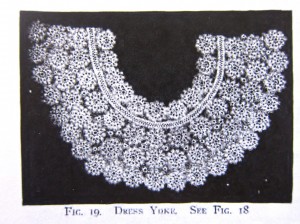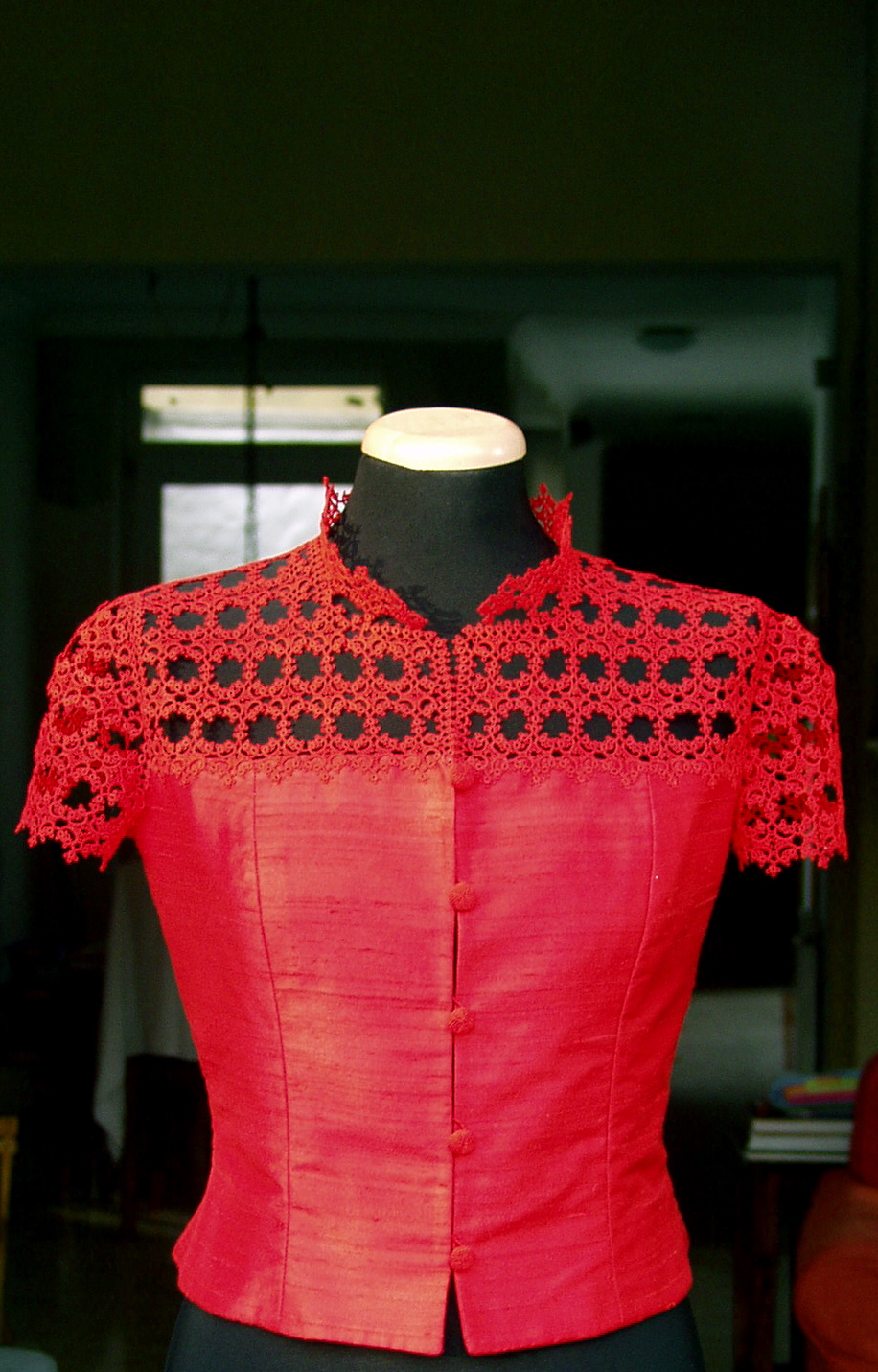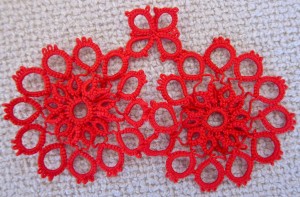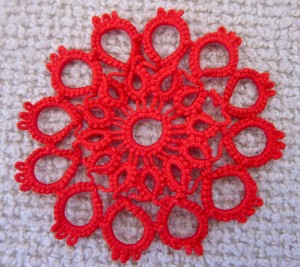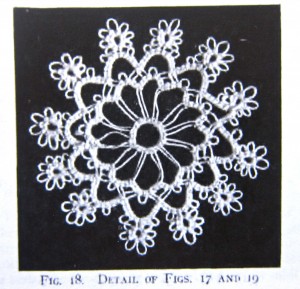
I really, really want to make one of these.

I found the most fantastic piece of tatting ever and now I really want to make one for myself.  I’ve got quite a lot of other projects to finish first, but this is definitely going on my “One Day I’ll Get Around to This” list.  I’ll be thinking about the basic design as I flip through the Priscilla books.  Hopefully, I’ll find a pattern in there that I can modify for it.  Maybe one of those yoke patterns.   In the meantime, I’ll just have to sit at my computer and drool over Orsi’s.

Comments (7)

Earring and Necklace for Shuttlebirds

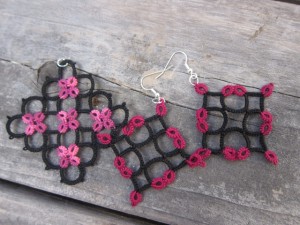
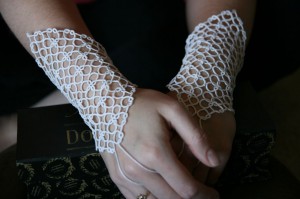
One of the classes I’m going to teach during Shuttlebirds this year is a necklace and earring design.  I’ve finally gotten around to tatting up the samples and taking the pictures for the Shuttlebirds website.  The necklace pendant is the original motif from my Variations on a Theme class from last year and the earrings are one of the simpler variations on it.  This little motif is AMAZING.  There’s so many different things you can do with it. It’s also the basis for a number of my different cuff and fingerless glove patterns.  I’m also working on some bigger pieces from it.  One will be a shawl and I think one will end up being a tablecloth.  The most amazing thing about these is that they’re all done in one piece.  NO motifs that need to be joined together.  These are very similar to Jean Younkin’s wedding shawl.  I tried finding a link to it.  It used to be hosted on Georgia Seitz’s website, but the link doesn’t seem to work now. 

I sell the booklet from my Variations on a Theme class from last year on my Etsy shop.  Depending on how much time I have before Shuttlebirds (OMG, less than 10 weeks until the workshop!) I may get around to writing up a bunch of other variations and having the expanded booklets for sell at the workshop.  If I do that what sorts of patterns do you think people would be interested in?  Fingerless gloves? Bracelets?  Small motifs like the necklace pendant and earrings? Should I write up the shawl?

Since the pendant is the original motif I’ve got that one all written up and ready for teaching.  Next step is to do the earrings and maybe tat up a couple of samples with beads.  (They look super awesome.)  Then I need to tackle the prep for my other classes.

Comments (5)

Shuttlebirds!

I just wanted to post quickly today to remind everyone that registration for the Shuttlebirds workshop is OPEN! Mark your calendars for April 15-16 in Spokane, WA.

Somehow I’ve ended up agreeing to teach during all 5 class periods and I just heard that one of my classes (on tatting an awesome coin purse) is already full.  I should take that as a really good sign it’s time for me to get off my butt and tat up my samples and write up my patterns.

I suspect that the next couple weeks I’ll probably be focused on that and most of my Priscilla tatting time will be working on the doily and the baby bonnet.  Hopefully, I’ll still have the time to work out some new Priscilla patterns.  I’ll definitely want to teach something from the Priscilla books next year so I want to have some options to show people at the workshop this year and get feedback.

The Shuttlebirds workshop is always a ton of fun.  I love getting to hang out with other tatters.  April 15th can’t get here soon enough!

Comments (8)

In Which Threads are Cut and a Few Tears are Shed Over the Baby Bonnet.

I did know there would be problems in putting together a piece with so little instruction to go on (I am not THAT naive), but I must admit I didn’t expect to hit them this early.  The instructions say that for the first 6 wheels you join them by two rings at a time while tatting them so that’s what I did. It looked like the more difficult part would come later so I figured I just tat those first 6 wheels and sort through the next part when I got there.

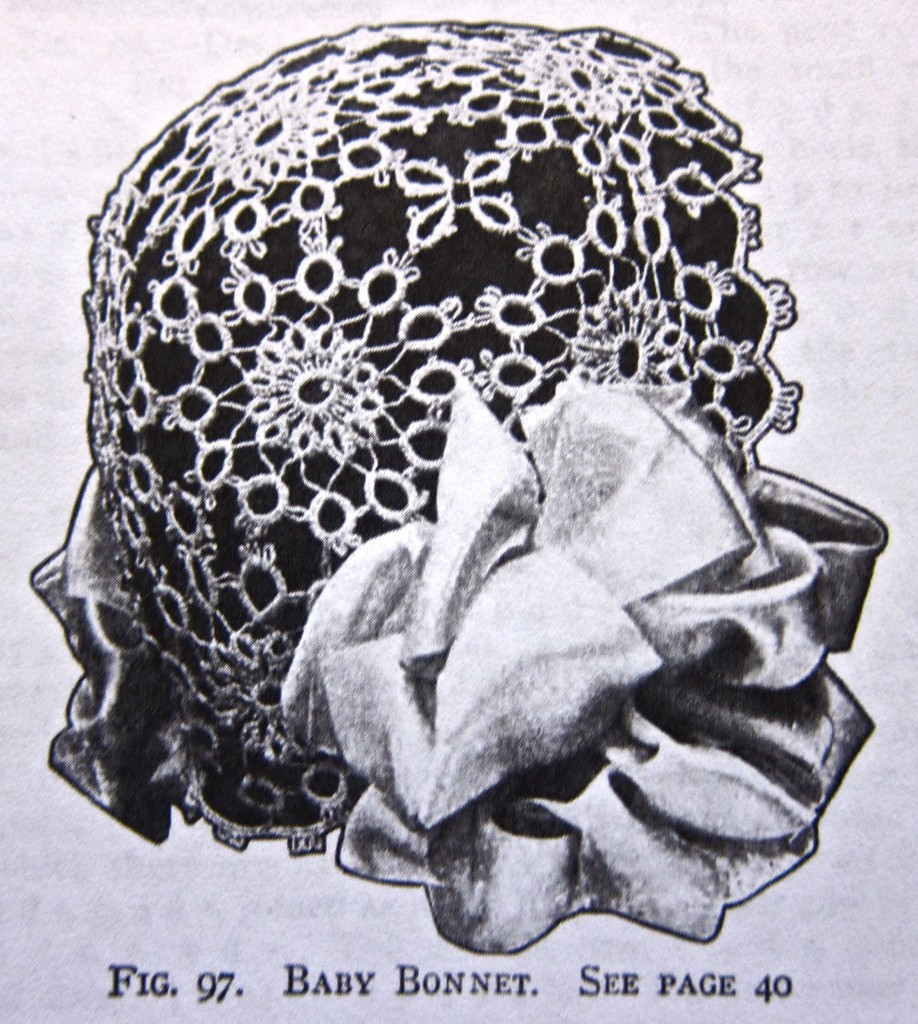
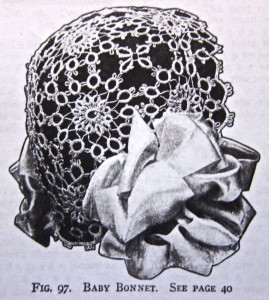
Unfortunately, lacking any instruction to the contrary I assumed that they should be joined straight.  The two rings opposite the previous joining pair being the pair of rings that would join one wheel to the next.   Last night, MUCH closer inspection of the only picture of the bonnet showed that, sadly, this is not the case.  Here again is the only picture of this project in the book.  I’m going to make it super large so it’s easier for you to see what I’m about to explain.

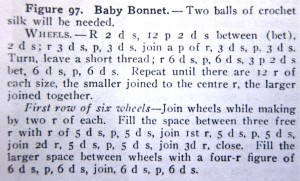
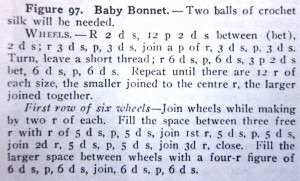
I’m also going to give the instructions again so you can see what we have to work with.

I’m assuming that the “row of six wheels” they talk about is the front part of the baby bonnet.  There is only one picture of the “join by two rings” but I assumed that the following wheel would be joined by the two rings opposite the first.  This gives you 4 rings on either side between the wheels.  The problem came with I started looking carefully at the joining of the two wheels on the very top of the bonnet.  I’m calling the wheel on the first row wheel #3, counting up from the closer side of the row.

I assumed the top wheel in the next row would be joined to wheel #3 by two rings like the first.  There are 3 picots on each of the outer rings and it appeared that one pair of rings was joined by the center ring and one pair by two of the outer picots.  That’s what got me to look closer where I realized the two wheels were actually joined by 3 rings, not two.  Problem is, that if there are only 4 free rings on wheel #3 on the inside between wheels #2 and #4 this meant they would be pretty uneven.  You can see the negative space filler between where #3 is joined to #2 and where it’s joined to the inner wheel.  BUT on the very edge of the bonnet it still looks like there’s ANOTHER negative space filler between wheels #3, #4 and the inner wheel.

I don’t know if any of this is actually making sense.  It’s hard to write it out in a way that’s clear, but suffice it to say that the first row is NOT straight and my little set of 7 wheels was totally wrong.  So I stared at it for a while and then took the scissors to wheels #2 and 4 leaving me with two sets of 2 wheels and one wheel by itself.  So not TOO much lost (hence only a FEW tears).  I’ve also decided that since this is really just a practice run and I don’t expect the finish product to look decent anyway from now on I’m not going to join the wheels as I go.  Instead I’m just going to tat up a whole bunch of them (the pattern doesn’t even say how many the finished bonnet should have), then I’ll join them just by tying the picots together so I can easily rearrange them without having to tat more.  I’ll probably join the negative space fillers as I go though since there’s not much tatting to those and I don’t mind cutting them up.

It’s funny, the first line of the instructions say that “two balls of crochet silk will be needed”  I don’t know how big a ball of crochet silk was in 1915 so I assumed it must have been pretty small.  Afterall, it doesn’t look like this pattern uses very much thread.  Clearly though the authors were expecting that you’d have to re-do the pattern a couple times and extra thread would be needed.

Comments (6)

Getting to Know the Star Doily Motif Even Better

I now know that to tat the motif for the Star Doily I should have just under two wingspans of thread on my shuttle.  Start to finish without any breaks or mistakes it takes 1 hour and 15 minutes for each Motif, (including winding the thread).  But the second piece of data is only based on a sample set of one because it’s not often I have that long to sit and tat uninterrupted.  So let’s assume 1 hour 20 minutes.

There’s 30 of the large motifs total in the doily, so 40 hours plus some small change for the small motifs and mistakes, maybe 43 hours.  That’s the tatting portion of it and then there’s the actual sewing on and cutting off of the fabric center.  Add blocking and the photographing and let’s round up to a nice even 50 hours.

I’ve got 8 large motifs and 1 small one done so far so I’d guess I’m around 11 hours into it at this point.  That’s actually not too bad.

Forgive the OCDness of this post.  I like to know how long it takes me to do portions of patterns so I can better fit them around daily tasks.  Once I timed myself doing the motif I had to go and figure out how long for the whole pattern.

Course getting to know the motif doesn’t mean I’m not going to make mistakes here.  This was a fun one:

Forgive the poor picture.  It I took it at night so the color isn’t quite right.  I got half way around the last row before I realized I was doing the wrong picot count.  (I was doing the one from the second round).  Rather than picking out all those stitches I decided to just finish it off and throw a jump ring on it and turn it into a large pendant.

Leave a Comment

More of the Baby Bonnet

This will be a quick post as I have a very busy week with my current class.  The final is on Saturday so wish me luck!  This class (Advanced Financial Accounting) is supposed to be the most difficult class in the accounting masters program so I’ll be glad to be done with it.  They say the rest of the program is just as much work, but it’s less confusing.  I actually thought the intermediate classes were harder, but that’s mostly because they encompassed so MUCH material.  In this one it’s harder stuff, but less topics so we got to spend a bit more time with each.

Anyway.  You don’t care about accounting and for the next fifteen minutes or so while I write this post, I don’t care about it either.

Today is basically a little progress report on the bonnet.  I’ve done a second wheel motif and one of the small negative space fillers that connects both. However, I just noticed that I joined the space filler to the wrong rings of the wheels.  I’ll have to cut it out and do it again, but I’ll post it anyway so you can get the idea.

The wheels are joined on two adjacent rings.  There are three picots at the top of each ring and I didn’t know if they were supposed to be joined using all three picots or just the center one.  (The directions are vague as usual.) I choose just the centers, but I think in the future I’ll join using all three just to make it stronger.  I’ll do the next one that way, at least, just to see what it looks like.  This first attempt at the baby bonnet will definitely just be a proof of concept version, so I’m not too worried about looks this time around.

I’m still trying to figure out exactly how long the picots on the first ring and the spaces between the rings should be.  I think the picots on the first ring definitely have to be longer than normal picots to get the inside round of rings to lay flat.  In the book it looks like the joining picots on the larger rings are longer and that might help sort out the length of thread between the rings.

The small bit of negative space filler is SUPPOSED to join to the two rings on the wheels closest to the rings that join the wheels together.  I didn’t have my book with me when I did it so I guessed and got it wrong.  The little space filler is just 4 unconnected rings of 6-6(- or +)6-6 with that picot vs join depending on which wheels you’ve got done.

That’s probably it for me until Monday.  I’ve got the final on Saturday and our research paper due Sunday at midnight so until then it will be mostly just accounting for me.

Leave a Comment

Start of the First Baby Bonnet

I’ve just started the first of 6 baby bonnets in the Priscilla books.  This one is in book #2.  I picked this one because frankly, it looked like it would be the fastest of them.  The others looked like they were made from a much smaller thread and for my first bonnet I wanted one that I could do over easily a couple times if I couldn’t get it right.

I’m usually not big on single shuttle tatting or leaving plain threads instead of chains, but for this I think it works.  The bonnet is made mostly of a circular motif.  (Seems I’ll be learning a lot of different circular motifs during the course of this Priscilla project.)

The problem is the book doesn’t actually tell you how many or what size thread to use.  The instructions say:  “Two balls of crochet silk will be needed.”  I’m not sure what size that translates into in modern day, but I’m trying it first in DMC size 10.  I picked that size just because it looked like the size in the picture, but having done the first round now I think perhaps I had an adult sized head in mind and not an infants.  I’m going to continue with the size 10 though just to see what happens.  Also, I think that with some adjustments it could be made into a wedding veil so I want to see what works for an adult-sized head.

On to the wheel motif.  As usual, my main change is to use the continue thread method and climb out from the center ring to the second round.  In this case it’s a single shuttle pattern so I use made the first ring about 12 inches from the end of the ring and finger tatted the second half of the split ring that does the climbing out.

Leave at least a 12 inch tail, R 2(-2)x11.  Picots should be longer than normal joining picots.  (Forgive the the vagueness here.  I’m still trying to figure out how long they should be.  I think around a quarter of an inch.

Leave mock picot and tat split ring of 3-3/3-3 using the tail for the second half

Leave at least a 1/4 inch thread between all rings.  (Sorry again for the vagueness.  Still working this out.)

Alternate large and small rings.  Join Large Rings to previous Large Ring.  Join first picot of Small Rings to previous Small Ring and second picot to the next picot on the center ring.

LR 6-6-2-2-6-6

*SR 3+3+3-3

LR 6+6-2-2-6-6

Repeat from * around center ring.  Join last Small Ring to first Small Ring.  Join last Large Ring to first Large Ring.

Tie thread to original tail and hide ends.

This is a easy motif that I can do while walking, so hopefully I’ll make fairly quick progress on the bonnet.  The next step is figuring out how the pieces fit together and then how (and when) to do the small motifs that fill the negative space.

The big bow on the bonnet in the picture looks nice, but it’s rather annoying since they don’t give very many instructions on how to put together the piece and the bow hides a big chunk of it.  They do say the first row is 6 wheels in a row joined by two rings each so I’ll start with that and then see what looks right when I get that far.

Comments (3)

Circular Motif for Yokes

Been focused mainly on making progress on a new custom piece. It’s for a belly dancer and one of my bracelet designs, but made bigger to fit around her upperarm.  I can’t wait to see what it looks like with the rest of her belly dancing costume.

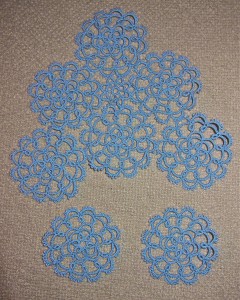
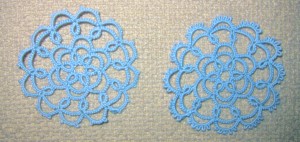
I did take a break from that project today and finished up this awesome little circular motif from pages 5 and 6 of the first Priscilla book.  I used some of the blue thread left on my shuttles from the star doily and surprisingly, managed to have almost exactly the right amount left on the shuttle for it.  Love when that happens.

I also love the idea of a single join to two separate picots at the same time.  It’s something I’d been contemplating, but never actually tried and I think this is the first place I’ve seen it done.  I use the point on my shuttle rather than a crochet hook for my joins, but using a crochet hook would probably make this double join a lot easier.  It’s not a pattern that I’ll be able to do easily while walking (yes, I tat while walking and hiking) but I really liked the way this motif came out.

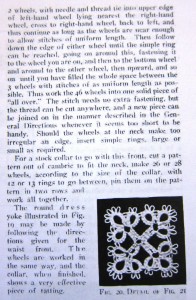
The book gives two yoke designs to use this motif for.  I haven’t decided if I’m going to do projects that big out of it.  Or rather, I doubt I’ll make a yoke, but may find some other large project for it.  I’m trying not to start any more large projects right now.  I’ve got enough going already so I want to finish a couple others soon.  For large Priscilla related projects I just want to focus on finishing the star doily and a baby bonnet from another Priscilla pattern that I’ve been eying and will probably start soon.

ANYWAY.  Let’s get on to awesome double-joining pattern for this motif, shall we?
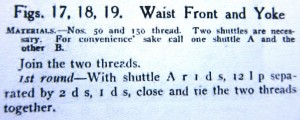
Don’t be intimidated by the length of these directions in the book.  Most of them are for the finishing technique and for putting together two different yokes out of this motif.

I didn’t actually try the finishing technique, but I didn’t find it necessary.  The reason given for doing it is to make the motif come out flat and even without blocking.  My motif didn’t seem to need anything, but I did make it out of size 10 thread, so that might have made the difference.  The book called for size 50.
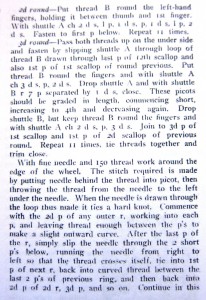
Here’s the instructions for the motif.  I’m including the pictures of the instructions for the finishing of the motif, but I didn’t do them on mine.  The only difference between the instructions as written and what I did was to climb out of the first ring with a mock picot rather than to cut and tie as they usually have you do.

Wind two shuttles using the CTM.

Round 1

With shuttle 1, R 2(-2)x11  Picots should be very long.

Round 2

Leave a mock picot,

*Ch 2-1-1-2 leaving the first half of the first stitch unflipped to lock the threads in place.

Shuttle join to next picot on ring.

Repeat from *, working your way around all picots of the center ring.  Last join of this round will be into the mock picot.

Join at the same time to both the first picot of the first chain and the last picot of the last chain.

** Ch 3-2

With Shuttle 2 (the same shuttle as made the stitches of the chains) R 1(-1)x7  Picots should increase in size until the 4th picot and then decrease in size.

Ch 2-3.  Shuttle join (Shuttle 1) to TWO picots of the previous round. Both the picot before and the picot after the previous round’s joins to the center ring.

Repeat from **, working your way round the motif.  Final chain should be joined to the last picot of the second round.

Hide ends and cut.

Here’s how mine came out:

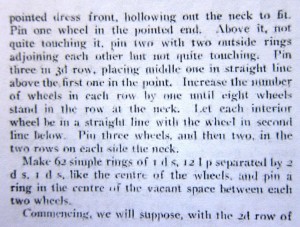
So that makes the basic motif.  The instruction continue and want you to use size 150 (I think that’s the size of sewing thread) to weave around the motif.  This is suppose to give it shape, I guess.  I didn’t do that and not sure that it needed it, but maybe I’ll try it in the future.   The instructions continue and give you directions to make the two yokes below.

I don’t have any need for yokes.  I’m sure I’ll make more of these motifs and I like the way they look sewn together, but don’t know yet what I’ll actually make from them.  However, I’d like to make something that’s actually useful.  Ideas?

Comments (11)

Progress on the Star Doily

I’ve made a bit of progress on the star doily in the last couple days. Here’s the post about the original motif.

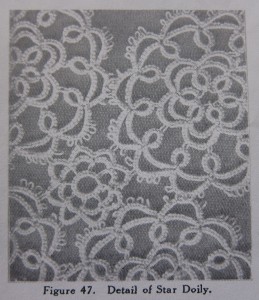
The new part in this project is the small motif used to fill the space between the larger motifs.  As written the pattern says to make the four motifs and then make the small motif, but it seemed a lot easier to make two of the large ones, then do the little one and then another two large ones.  Filling in small spaces just isn’t my idea of fun tatting.  Too fiddle-y.

I made a second motif joining it to the first on the final round by the middle 3 of the 5 picots on an outer chain.  The book didn’t actually say how to do the join and from the look of the picture to the left I couldn’t actually tell how the original was joined, but I figured 3 joins would make it nice and strong.

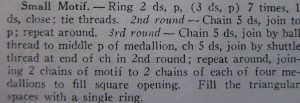
I think the small motif would make an excellent small pendant or a pair of earrings.  Actually the center part of the large one would as well.  I’m adding these to my list of things to try when I have time.  The small motif is a fairly straight forward one.  My only slight confusion was to the first (and only) ring.  They call for you to tie the threads, but don’t say to cut.  Presumably they intended for you to cuqt them since that seems to be what was common at the time and they don’t then have you joining the thread to the first picot as I’ve seen them do.

Anyway, it’s a small matter because I just started the ring at a picot and left the shuttle on the ball.  After closing the ring I  made a mock picot after the ring by not flipping the first half of the first stitch of the first chain. (Wow, three firsts in one sentence.)  That seemed to do the trick as far as making sure there was a mock picot between the ring and the chain.

Here are the instructions as I did them (These instructions are for the motif alone.  For joining them to the large motifs you’ll just have to look at the picture above.  I can’t figure out how to explain where to make the joins and it’s one of those cases where a picture is worth a thousand words.):

R 3(-3)x7 (picots should be fairly long)

Round 2:

Leave space on threads after the ring of the same length as the picots.

*Ch 5, leaving the first half of the first stitch unflipped.

Shuttle join to next picot

Repeat from * 7 times around the ring.

Round 3:

**Ch 5-5 (joining were necessary to the large motifs previously made)

Shuttle join to top of next join on the previous round

Repeat from the ** 7 times.  Hide and cut ends.

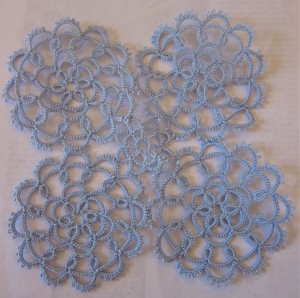
Not too bad for a little motif.  I discovered after the second round that I’d made my ring picots just a little bit too short so it didn’t lie as flat as I’d like.  I’ll have to keep that in mind when I do the next 4.  Otherwise it came out pretty well.  I should have taken a picture after I finished the small motif but I forgot to do it until I’d finished another two of the large motifs and joined them to the group.  Here’s where I’m at this point:

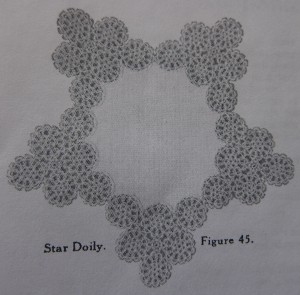
And here again is what the finished doily will look like:

I can’t believe I’m actually making a doily.  I never thought I was that kind of tatter… ;)  Though I’m using size 10 thread so I think it’s going to come out pretty large.  MAYBE even large enough I can call it a tablecloth.  That seems more respectable than a doily.

Comments (6)

Square Insertion

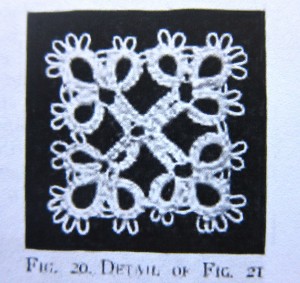
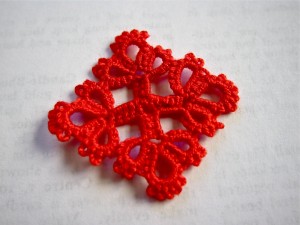
I wanted to do just a quick pattern today so I picked out the small square insertion on page 6 of the first Priscilla book.  I liked the right angles you get by joining all the chains up in one spot on the center.  I also liked that it worked up pretty quickly with the thread left on my shuttle from the earlier rose motif.  Here’s the instructions:

Use CTM

*R  6-2-1-1-4

R 4+2(-1)x4-2-4

R 4+1-1-2-6

CH4-4

Repeat from * 3 times, joining the first ring of each clover to the last ring of the previous clover.  Also join the chains to the first chain at the picot.

This might be the first time I’ve said this with regards to the Priscilla Project, but I didn’t have any changes to the pattern as written.  Well, unless you count the fact that I’m not going to make another 35 of these and sew them to a piece of fabric to use as a centerpiece.  Smaller pieces like this are starting to grow on me, but not enough to do another 35 of them.  I think adding a jump ring and turning this little motif into a pendant will be a fine place to stop.

Comments (7)