Archive for Priscilla Project

A Return of the Rose Motif From Hell (Not So Hellish the Second Time Around

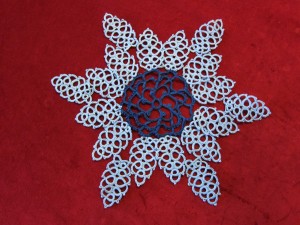
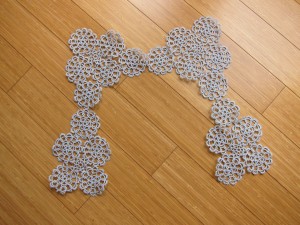
Two of the first patterns I tackled in this little project of working my way through the Priscilla tatting books were the leaf and rose motifs from this… doily(? Seems too big to just be a doily, but I suppose it all depends on the size thread you use.)

As you may recall, I renamed the rose motif, The Rose Motif From Hell because it was such a pain in the butt to do with the 1925 version of split chains (which are actually easier than the modern day version, but don’t look like the normal tatted stitches).

At the time I wasn’t sure if I’d ever go back and look at the pattern again, but time has past and as the memory frustration faded I decided to tackle it again on my train trip from San Diego to Seattle a few months ago.

The main thing that I wanted to figure out with this pattern is a way to make the leaves directly on to the roses.  The instructions (as usual) are unclear on how to actually put the pieces together.  The just say that there are 109 rose motifs (Yes, 109!) and 162 leaves.  Then later in the instructions they say to join the motifs together.  No explanation of how, though I suspect there’s supposed to be sewing involved.

I played around with it in size 20 thread and actually got to liking it though I didn’t get too far.  Just enough to figure out a way to make two of the leaves at the same time while attaching them to the center motif while tatting them.  That was two months ago and of course now I can’t find those pieces that I was playing around with, but I have decided to go ahead and try out the center part of the project.  I make no promises to doing the whole thing, but I just had to try some more of it.

Not wanting to end up with a doily, I’ve decided to make it in size 3 so that if I DO decide to go ahead and make the whole thing I’ll end up with a small tablecloth.

Finding a way to add ALL the leaves around the center motif in one go might be  a project that’s doomed to failure just because with a piece this large it IS probably easier to make sure it lays flat if you make all the motifs separate and then are able to make easy adjustments while sewing them together.  I could be setting myself up for more frustration, but my tatting sensibilities are such that I really prefer to put together the piece while tatting rather than later.  (Though I do like the idea seeing what of a stacks of 109 rose motifs and 162 leaves would look like…) Also, at this point, I’m not planning on doing the whole thing so hopefully that should make it easier to get flat.

Making and attaching the leaves in sets of two seems to work pretty well.  There’s enough give/overlap between the sets that it lays nice and flat so far.  Adding the next set of 6 roses around shouldn’t be a problem, and it should still lay nice and flat.  What will be interesting is when I add the round that’s all rose motifs, (18 of them!).  That could get more complicated.  I’m going to give it a try anyways.  The knot-stitch is actually pretty fun once you get the hang of it and in size 3 thread it’s MUCH easier to control.

No promise on how long it’s going to take me to do the next 24 rose motifs that the next two steps of this pattern require.  I’ve got too many projects started right now, I should probably try to finish up a couple of them at some point….


Comments (11)

The New Belt is Finished (Sort of)

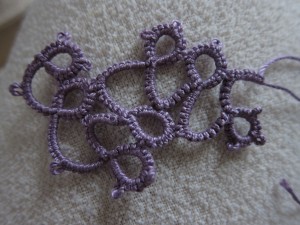
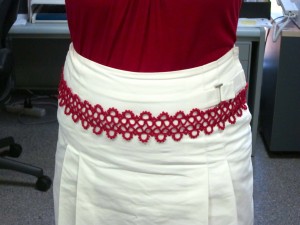
I’ve actually got this belt finish, (mostly, I’ll clarify at the bottom of this post) but don’t have good pictures and have it packed at the moment.  I took the train back from San Diego to Seattle this week and haven’t gotten myself organized again yet.  I did take pictures earlier on in the project so I’m going to post those and go through the pattern.  I’ll post the finished pictures when I get unpacked, but here’s what it looked like when I had finished one strip of it.
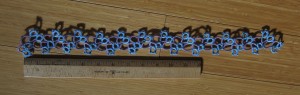
The whole thing was just under 18 inches.  When I made my first belt I made the tatting portion of it 27 inches long so that it would be the largest part of the belt, but I ended up liking the way the ribbon looked (especially once I added a little bit of tatting to it to cover up how I attached it to the main part of the belt) and decided that for the next one I’d make the main tatting portion of it smaller.  So sadly, the difference in the the sizes of the two is an astethics thing and not that I lost 9 inches around my waist.  :(  If I want to lose 9 inches off my waist I probably shouldn’t spend my time sitting on the couch tatting.  (Actually, I do tat while hiking, but I haven’t done that lately.)

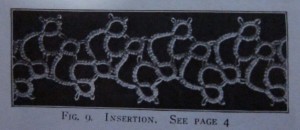
Anyway, here’s the original pattern:
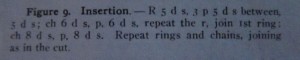
Nice and simple, right?  Well, if you have the picture in front of you.  It’s actually a little trickier than written because the joins aren’t intuitive.  I love how they just say “joining as in the cut”.  Though, admittedly, it’d be a pain in the butt to explain write it all out and it probably wouldn’t make sense.  You really do need to have the picture in front of you for the first couple repeats.  Here’s “the cut”:

Instead of the 6-6 chains I did 5-5.  Just seemed to work better for me, but that’s probably a function of how I tat.  I think my chains tend to be looser than my rings so if you’re going to try the pattern, see what works for you.  Other than that I didn’t change anything, but I did add a shoelace trick after the first ring for every repeat after the first to keep the chains from twisting.  (If you’re doing it all in one color you could just use two shuttles and switch which is the ring shuttle and which is the chain shuttle with each repeat)  There’s also some annoying stuff going on with the joins if you pay attention to frontside/backside tatting.  I don’t normally, and didn’t worry about it on this as far as doing my rings vs. chains, but  in this pattern you’re joining chains to rings so you do need to pay attention to it for the joins.  I’ll explain that after the pattern.

Here’s my modernized shorthand version of the instructions.  I’ll label the rings R1 and R2 and the chains Ch1 and Ch2 so that hopefully my explanation of where to do the joins will make more sense.

(R1) 5-5-5-5  (NEVER joined to anything when first tatted.  (This was hard for me to remember.  Lots of retro-tatting because of this.))

*(Ch1) 5-5 (after the first round, this is always joined at the picot to the last picot of R2 from the previous repeat.)

(R2) 5+(always joined to the last picot of the first ring) 5-5-5

(Ch2) 8-8 (always joined at the picot to the middle (2nd) picot of R2 from the PREVIOUS repeat.)

(R1) 5-5-5-5.  (Note that this ring is NOT joined to anything.)

Shoelace trick to switch the threads before the next chain.

Repeat from * joining as described.

Does all that make sense?  Let me know if this is clear.  (Part of the whole point of doing this blog is for practice in writing up patterns, so please, always feel free to let me know what’s helpful and what’s confusing).  Would it make more sense if the the “guidelines” for joining were written after the pattern when you’re working on the second repeat?

Finally, a note about the joins.  If you’re using two colors you have to pay attention to your joins because you’re doing joins of chains to rings.  When you do a join with threads of different colors you get a little blip of color with your joins.  Usually I don’t worry about that and just call the side where that happens the “back” side.  Problem is that with this pattern you do a shoelace trick to reverse the work with each repeat.  This means that the blips of color are not all on the same side of the tatting anymore.  They switch sides with each repeat.  Arg.

If you want to avoid the color you’ve got to switch your type of join with each repeat.  I usually do an up join, but for every other repeat I needed to do a down join for the chains to rings joins.  Pain. In. The. Butt. Very hard to remember and I did it wrong a few times so I’ve still got the blips of color on both sides.  I might not have worried much except that since I was using size 3 thread on this the colors are petty noticeable.  (To me anyway).  At Camp Wannatat, Sandy showed me the Larks Head join which is more work, but gets rid of the blip.  This would have been a good project to practice this on, but unfortunately, I totally forgot about it until after I finished the tatting.  Another time, perhaps.

When I started messing around with this pattern I picked it because I wanted a relatively thick edging that could be done in one pass.  I wasn’t sure if I would like the final version because I didn’t know if it worked in just one color.  Seemed too chaotic.  I think it’s much better in two colors and I like it this way, but decided I’d do the doubled over version anyway to make a really wide belt.  I’m just a sucker for symmetry, and even though the final version doesn’t have left-right symmetry, it does have top-bottom symmetry and that makes me feel better…

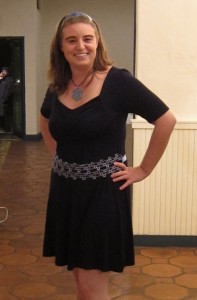
So I tatted up a second row and added it to the first as I went.  The whole frontside/backside tatting with regards to the joins was an even bigger pain in the butt to keep track of for the second row, so there’s a bunch of mistakes there too. I decided at the last minute to wear it to a wedding. (Picture on the right.  Don’t you love the matching necklace!  That’s the center part of the motif from the star doily in Priscilla Book #3 in the same size 3 blue thread as the rings on the belt.  The color is a little funky in the picture, but the dress is actually a dark blue, not black.)  I ended up sewing on the ribbons at my friend’s hotel room when I went to pick her up to head over to the church.  This means that I haven’t yet gotten around to tatting up something to cover the sewing.  I do have an idea for that though, so maybe sometime this week.  When I’m done with the “finishing” work I’ll take more pictures of the whole thing.
I’ve really enjoyed making belts.  They work up pretty quickly in size 3 thread and it’ll be fun to have a bunch of them to easily add some lace to dresses.  Plus, they’ll be a great way to try out a lot of the edgings in the Priscilla books.  Since I think I’m going to make more I’ve even gone and given them their own category to the right.  This way all the belts will be easily browse-able.

Comments (2)

Picking a Pattern for a New Belt Project

Michael’s had ribbon on sale last week and I couldn’t resist picking up a few new colors to try out with some new tatted belts.  There’s a particular pattern in Priscilla Book #2 that’s been bothering me lately.  I can’t decide if I like it or not, but I think it might make a nice belt.  And if it turns out I still don’t like it?  Well, at least I’ll be tatting it in size 3 thread so it should go quickly.

For the last belt I made I used a ring and chain pattern that had to be doubled over to give it vertical symmetry and make it the right width for the belt. This meant tatting one side of the belt and then flipping it over and tatting the other side. It’s been my normal way of turning edgings into bracelets or necklaces or anything I want to be thicker, but I’ve been wanting to find a pattern I like that can be done in one pass and still result in a fairly wide piece of fabric.  Haven’t found one I really like yet.

This pattern has been catching my eye because it’s done in one pass and it looks like it ends up being fairly wide.  I’m just not sure I like it.  It’s hard to follow and feels a bit chaotic.  I tatted up a small piece of it just to get a feel for the pattern and still wasn’t totally sure about it.  (Wish I could have tatted a longer piece, but I ran out of shuttle thread.  Size 3 goes pretty quickly.)  I think tatting it in two different colors will help to give it a little more definition.  The rings in the pattern come in pairs and the chains should form something of a wave of color bending around the pairs of rings.  I’m going to try it out in two colors, and I’ll write up the pattern for it when I do.

Though my main attraction to this pattern is that it’s done with only one pass, it’s not totally symmetric and I’m starting to wonder what it would look like doubled over.  Though a single pass should be wide enough for a belt doubled over might looking interesting as a super-wide belt (or normal sized with size 10 thread).  I may end up trying that as well.  I will say that I really like using the size 3 thread for belts because I think then they’re actually big enough that you can see the design from farther away.  Belts are not really meant to be looked at up close.  At least, I’d rather not have people bend down and take a look at my waist from 6 inches away, but hey, maybe that’s YOUR thing…

Comments (2)

Been Tatting (Even if Not Posting…)

The finished doily sans center fabric.

I’ve been busy tatting though not posting.  Internet time continues to be short on the road.  Lots of tatting related stuff to talk about, though.  x

I’ve finished the tatting portion of the star doily from the 3rd Priscilla Tatting Book.  Unfortunately, it took longer than it should have because not once, but twice I managed to connect the pieces wrong. You think I would have learned after the first time, but no.  I misunderstood the mistake I made so I made it again.  The standard rule in tatting is to “check twice, close once” with regards to making rings.  Another should be “check twice, join once” with regards to putting together medallions and motifs.

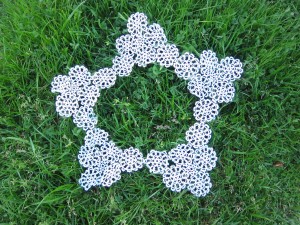
As I mentioned in an earlier post about the doily I was piecing it together by creating the “points” of the star first and then tatting the medallions between them to connect them all at once.  It’s a nice way to do it for this doily because it means that you avoid having to deal with a really large piece of tatting until you’re near the end.  Problem is that I managed to “flip” one of the points of the star while joining so it pointed inward.  Didn’t figure out what I’d done until I did it again and so I had to cut the last row of both the joining medallions.  Luckily I could get away with only cutting out the last (chains-only) row and one of the rings from the previous row.  So the actual fixing wasn’t too difficult or take too long.  Though I still put it aside until just this last week because I wanted to be focused while doing it to make sure I didn’t make the same mistake again.  Lately all my “focused” tatting time (meaning tatting that I actually have to pay attention to while I’m doing) has been spent on working on stuff for the classes I’m teaching at the Shuttlebirds Workshop in Spokane.

That’s it for now.  I’ve been sitting here at Starbucks for the last few hours reading my “Governmental and Nonprofit Accounting” textbook and getting started on my homework for my new class.  First class is tomorrow night and I want to start off ahead because I’ve got so much going on in the next couple weeks.  Classes are only 4 weeks long so there NO way to get caught-up if you get behind.  Tired of the smell of coffee (which I don’t drink) and it’s time to get out of here.

Comments (2)

Just One More Section Left on the Star Doily

I suppose I shouldn’t get too excited about it because even once I’ve finished the tatting I’ll still need to figure out how to attach the piece to the center fabric.  Still, it’s nice to see the doily taking shape.  If I keep up at the rate I’ve been going I should have the tatting portion finished.

I’ve also been working on writing up the handouts for the classes I’m teaching at the Shuttlebirds workshop this year.  I’ve got 5 classes and want to finish up the handouts for the 3 easier ones this week.  The other two are going to take a lot more experimenting to get right so will take longer, but if I can get the first three done I’ll feel like I’ve got a handle on everything for the workshop.

One of the classes that’s going to take more time to prepare for is the one called “Blocking, Starching and Care of Tatting”.  I proposed it as a class largely because it’s something I want to learn a lot more about myself.  I have a final for class on Saturday and I plan using some of my new extra free time the rest of the weekend for some starching and blocking of snowflakes.  Anyone have some blocking, starching or care of tatting tips for me to try out?  I also want to mess around with figuring out a portable blocking system that I can take with me to the workshop.

Comments (2)

Sash Belt is Finished!

It’s so nice to finish large project and it’s amazing how having a deadline will actually force you to do it.  I wanted to wear my new belt for Valentine’s day so I finally sat down over the weekend and finished it off.  Doesn’t it look lovely in my co-worker’s office?  (Had to take it there because she actually has a window and real sunlight.)  Finishing off the belt didn’t actually take too long because I’ve had the main part of the belt tatted for over a month now.  The next step was to attach the ribbons that would tie in the back and add tatting to them to make them look  little fancier.

Adding this little bit of tatting to the bows also gave me a chance to check off 4(!) more patterns in the Priscilla books.  Technically, it’s two, but their both very simple patterns repeated in both the 1st and the 3rd book.  Maybe that’s sort of cheating, but hey, my project, my math.

I don’t have the books in front of me so I’m not going to do the normal pictures of the figures in the books and the pattern as written.  Maybe I’ll write it up in a future post, but I don’t think that’s really necessary.  They’re pretty standard.  Here’s the basic process I used to make them.

NOTE:  I consider this whole piece just a proof-of-concept piece to get a rough idea of what would be involved in making some belts like this so I just used fabric glue on the ribbon.  Normally I’d sew the tatting to it, but I was just looking for quick and dirty.  I got both.  🙂

I think this was the second pattern in both the first and the third Priscilla books.  The rings are all 3+3-3-3 with the first picot joining to alternating rows (so the 3rd ring joins to the 1st, the 4th ring joins to the 2nd, the 5th ring joins to the 3rd and so on).  The only change I made was to leave out the first picot on the first ring of each row and the last picot on the last ring of each row.  Then I folded the piece of tatting over the end of the ribbon and glued it down.

I wanted something that would cover both sides of the ribbon because it will flip around while your wearing it and this seems to work, though I don’t actually care much for the pattern.  I’m just not generally a fan of uncovered threads and it was especially hard to get them to lay flat in this situation.  But as I’ll say many times in this post, this was just a proof-of-concept version of the piece and in the future I’ll pick a more interesting pattern to use to cover the ribbons.

Attaching the ribbon to the tatting was also pretty easy thanks again to fabric glue and a really simple tatting pattern. Like the ends above I first folded over the ends and glued them down to get rid of the rough edges.  Then I passed the ribbon through the loop on the end of the tatting and glued it down onto itself.  Added a another piece of very simple tatting just to cover the edge.  This pattern is the very first pattern in both the 1909 and 1925 books. Rings of 3+3-3-3 with about 3/4-1 inch of thread between them.  Hate the way the uncovered thread looks (and the glue), but once again, this was just the proof-of-concept so it works for this.  Attached both ribbons the same way.

The original piece of tatting that makes up the main part of the belt is about 27 inches because I didn’t want the ends where it attaches to the ribbon to show from the front.  Now that I’ve got a finished version though I’m re-thinking this.  I actually think it work out pretty well and the ribbon attachments could be on the side or even a little bit on the front.  A fancy motif over the end of the ribbon would be a nice accent to the sides of the best.  AND that would have the added advantage of meaning less tatting would be needed for the main part of the belt.  Instead of 27 inches next time I’m going to try something more like 18 inches.

I forgot to take a close-up of the necklace I’m wearing in the first picture, but it’s actually the center part of the motif from the star doily I’m working on.  I made it out of the same size 3 thread that the belt is made of so it’s pretty big and loved the way it came out.  It’s nice to have such a bold piece of tatting.  I wore it again on Tuesday with a red dress and got lots of comments on it.   I think I may have to start doing a lot more tatting in size 3.  Originally, I picked size 3 for the belt just because I wanted it to work up really fast.  As a proof-of-concept piece I didn’t want to spend a lot of time on this first “draft” and figured that when/if I made more I’d make them out of a smaller thread and more complicated pattern.  I actually think now that size 3 totally works for the belt.  I do plan on trying out some other patterns for belts but I think I’ll stick with the size 3.

Amazing!  Once I learned how to tat nearly 10 years ago I used size 80 almost exclusively for many years.  I switched to size 30 when I discovered and fell in love with Altin Basak thread and now I use mostly size 10 and 20 and am thinking of moving up to size 3 for a lot of stuff!

Actually, I may even try working with Koigu’s merino yarn for some. Wildfiber, the yarn store in Santa Monica where I love to hang out and tat doesn’t carry any thread other than a small amount of embroidery thread.  But they do have a really comfortable area for hanging out and knitting/crocheting/tatting so I wanted to find something I could buy from them.  That way I wouldn’t feel too guilty about just coming in to hang out and use the couch space for tatting.  :)  I bought a remnant of the Koigu yarn to try tatting. I made a bracelet out of it a while back and really liked the way it came out.

It has to be either a relatively simple pattern or one that I know really well because it’s a pain in the butt to retro-tat with, but other than that it’s surprisingly easy to work with.  It’s kinda expensive though (at least compared to tatting thread which is hours and hours of tatting time for under $5), so I’ll be test tatting a couple other belts before I make that plunge.  I think it should work out to approximately the same size as size 3.

So stay tuned for that!  I think with the right pattern, some beads and the Koigu yarn I’ll end up with some really elegant belts.

P.S.  I promise in the future to come up with better names for big projects like this.  “Sash Belt” is still bugging me, I think because it sounds like “Slash Belt”.

Comments (3)

In Which Threads are Cut and a Few Tears are Shed Over the Baby Bonnet.

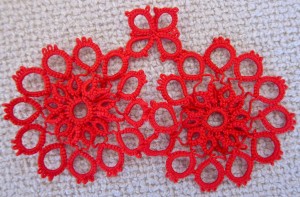
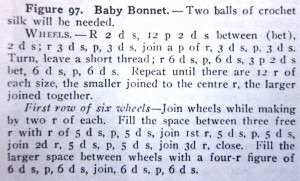
I did know there would be problems in putting together a piece with so little instruction to go on (I am not THAT naive), but I must admit I didn’t expect to hit them this early.  The instructions say that for the first 6 wheels you join them by two rings at a time while tatting them so that’s what I did. It looked like the more difficult part would come later so I figured I just tat those first 6 wheels and sort through the next part when I got there.

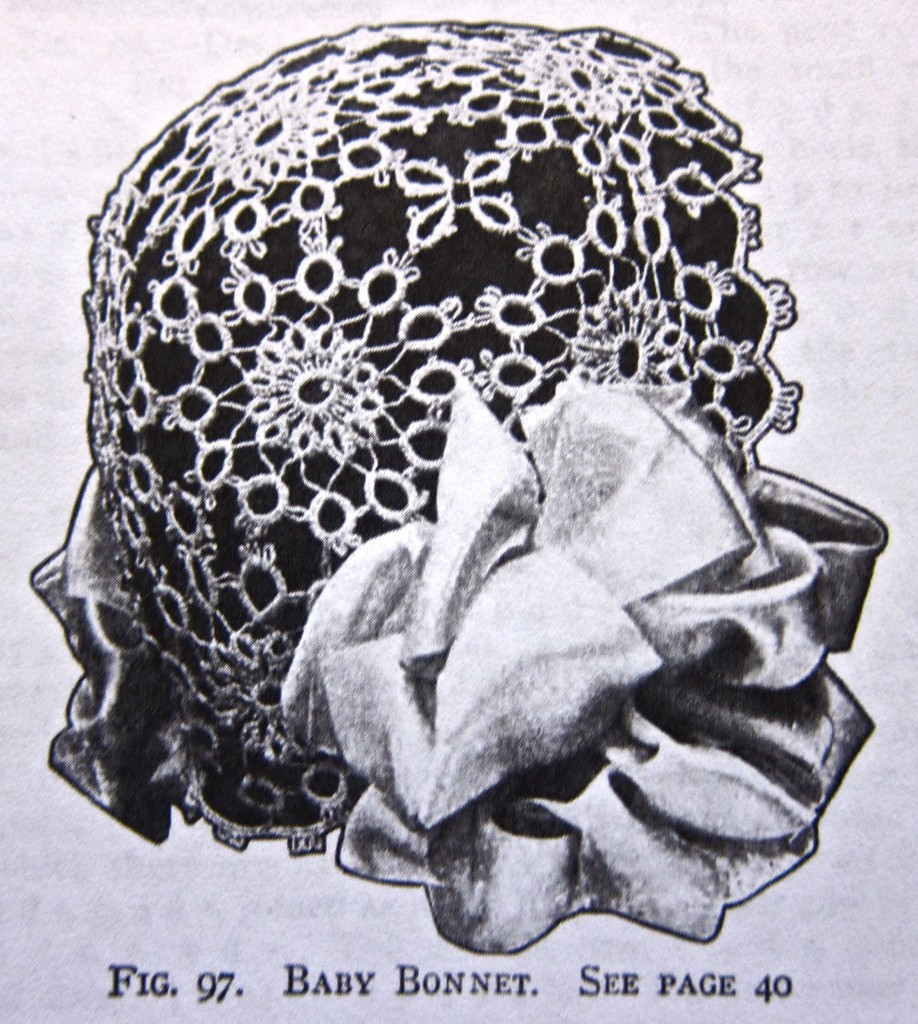
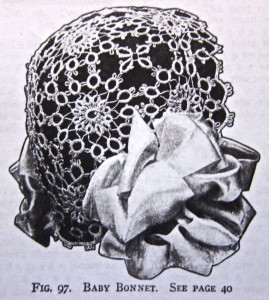
Unfortunately, lacking any instruction to the contrary I assumed that they should be joined straight.  The two rings opposite the previous joining pair being the pair of rings that would join one wheel to the next.   Last night, MUCH closer inspection of the only picture of the bonnet showed that, sadly, this is not the case.  Here again is the only picture of this project in the book.  I’m going to make it super large so it’s easier for you to see what I’m about to explain.

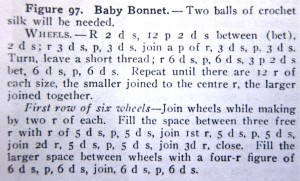
I’m also going to give the instructions again so you can see what we have to work with.

I’m assuming that the “row of six wheels” they talk about is the front part of the baby bonnet.  There is only one picture of the “join by two rings” but I assumed that the following wheel would be joined by the two rings opposite the first.  This gives you 4 rings on either side between the wheels.  The problem came with I started looking carefully at the joining of the two wheels on the very top of the bonnet.  I’m calling the wheel on the first row wheel #3, counting up from the closer side of the row.

I assumed the top wheel in the next row would be joined to wheel #3 by two rings like the first.  There are 3 picots on each of the outer rings and it appeared that one pair of rings was joined by the center ring and one pair by two of the outer picots.  That’s what got me to look closer where I realized the two wheels were actually joined by 3 rings, not two.  Problem is, that if there are only 4 free rings on wheel #3 on the inside between wheels #2 and #4 this meant they would be pretty uneven.  You can see the negative space filler between where #3 is joined to #2 and where it’s joined to the inner wheel.  BUT on the very edge of the bonnet it still looks like there’s ANOTHER negative space filler between wheels #3, #4 and the inner wheel.

I don’t know if any of this is actually making sense.  It’s hard to write it out in a way that’s clear, but suffice it to say that the first row is NOT straight and my little set of 7 wheels was totally wrong.  So I stared at it for a while and then took the scissors to wheels #2 and 4 leaving me with two sets of 2 wheels and one wheel by itself.  So not TOO much lost (hence only a FEW tears).  I’ve also decided that since this is really just a practice run and I don’t expect the finish product to look decent anyway from now on I’m not going to join the wheels as I go.  Instead I’m just going to tat up a whole bunch of them (the pattern doesn’t even say how many the finished bonnet should have), then I’ll join them just by tying the picots together so I can easily rearrange them without having to tat more.  I’ll probably join the negative space fillers as I go though since there’s not much tatting to those and I don’t mind cutting them up.

It’s funny, the first line of the instructions say that “two balls of crochet silk will be needed”  I don’t know how big a ball of crochet silk was in 1915 so I assumed it must have been pretty small.  Afterall, it doesn’t look like this pattern uses very much thread.  Clearly though the authors were expecting that you’d have to re-do the pattern a couple times and extra thread would be needed.

Comments (6)

Getting to Know the Star Doily Motif Even Better

I now know that to tat the motif for the Star Doily I should have just under two wingspans of thread on my shuttle.  Start to finish without any breaks or mistakes it takes 1 hour and 15 minutes for each Motif, (including winding the thread).  But the second piece of data is only based on a sample set of one because it’s not often I have that long to sit and tat uninterrupted.  So let’s assume 1 hour 20 minutes.

There’s 30 of the large motifs total in the doily, so 40 hours plus some small change for the small motifs and mistakes, maybe 43 hours.  That’s the tatting portion of it and then there’s the actual sewing on and cutting off of the fabric center.  Add blocking and the photographing and let’s round up to a nice even 50 hours.

I’ve got 8 large motifs and 1 small one done so far so I’d guess I’m around 11 hours into it at this point.  That’s actually not too bad.

Forgive the OCDness of this post.  I like to know how long it takes me to do portions of patterns so I can better fit them around daily tasks.  Once I timed myself doing the motif I had to go and figure out how long for the whole pattern.

Course getting to know the motif doesn’t mean I’m not going to make mistakes here.  This was a fun one:

Forgive the poor picture.  It I took it at night so the color isn’t quite right.  I got half way around the last row before I realized I was doing the wrong picot count.  (I was doing the one from the second round).  Rather than picking out all those stitches I decided to just finish it off and throw a jump ring on it and turn it into a large pendant.

Leave a Comment

More of the Baby Bonnet

This will be a quick post as I have a very busy week with my current class.  The final is on Saturday so wish me luck!  This class (Advanced Financial Accounting) is supposed to be the most difficult class in the accounting masters program so I’ll be glad to be done with it.  They say the rest of the program is just as much work, but it’s less confusing.  I actually thought the intermediate classes were harder, but that’s mostly because they encompassed so MUCH material.  In this one it’s harder stuff, but less topics so we got to spend a bit more time with each.

Anyway.  You don’t care about accounting and for the next fifteen minutes or so while I write this post, I don’t care about it either.

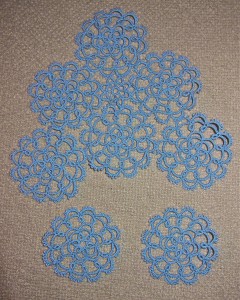
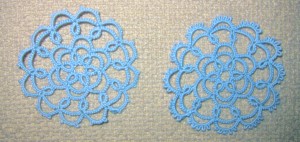
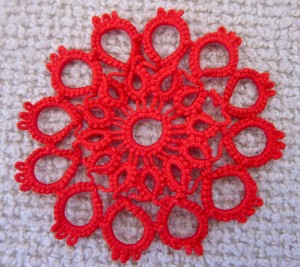
Today is basically a little progress report on the bonnet.  I’ve done a second wheel motif and one of the small negative space fillers that connects both. However, I just noticed that I joined the space filler to the wrong rings of the wheels.  I’ll have to cut it out and do it again, but I’ll post it anyway so you can get the idea.

The wheels are joined on two adjacent rings.  There are three picots at the top of each ring and I didn’t know if they were supposed to be joined using all three picots or just the center one.  (The directions are vague as usual.) I choose just the centers, but I think in the future I’ll join using all three just to make it stronger.  I’ll do the next one that way, at least, just to see what it looks like.  This first attempt at the baby bonnet will definitely just be a proof of concept version, so I’m not too worried about looks this time around.

I’m still trying to figure out exactly how long the picots on the first ring and the spaces between the rings should be.  I think the picots on the first ring definitely have to be longer than normal picots to get the inside round of rings to lay flat.  In the book it looks like the joining picots on the larger rings are longer and that might help sort out the length of thread between the rings.

The small bit of negative space filler is SUPPOSED to join to the two rings on the wheels closest to the rings that join the wheels together.  I didn’t have my book with me when I did it so I guessed and got it wrong.  The little space filler is just 4 unconnected rings of 6-6(- or +)6-6 with that picot vs join depending on which wheels you’ve got done.

That’s probably it for me until Monday.  I’ve got the final on Saturday and our research paper due Sunday at midnight so until then it will be mostly just accounting for me.

Leave a Comment

Start of the First Baby Bonnet

I’ve just started the first of 6 baby bonnets in the Priscilla books.  This one is in book #2.  I picked this one because frankly, it looked like it would be the fastest of them.  The others looked like they were made from a much smaller thread and for my first bonnet I wanted one that I could do over easily a couple times if I couldn’t get it right.

I’m usually not big on single shuttle tatting or leaving plain threads instead of chains, but for this I think it works.  The bonnet is made mostly of a circular motif.  (Seems I’ll be learning a lot of different circular motifs during the course of this Priscilla project.)

The problem is the book doesn’t actually tell you how many or what size thread to use.  The instructions say:  “Two balls of crochet silk will be needed.”  I’m not sure what size that translates into in modern day, but I’m trying it first in DMC size 10.  I picked that size just because it looked like the size in the picture, but having done the first round now I think perhaps I had an adult sized head in mind and not an infants.  I’m going to continue with the size 10 though just to see what happens.  Also, I think that with some adjustments it could be made into a wedding veil so I want to see what works for an adult-sized head.

On to the wheel motif.  As usual, my main change is to use the continue thread method and climb out from the center ring to the second round.  In this case it’s a single shuttle pattern so I use made the first ring about 12 inches from the end of the ring and finger tatted the second half of the split ring that does the climbing out.

Leave at least a 12 inch tail, R 2(-2)x11.  Picots should be longer than normal joining picots.  (Forgive the the vagueness here.  I’m still trying to figure out how long they should be.  I think around a quarter of an inch.

Leave mock picot and tat split ring of 3-3/3-3 using the tail for the second half

Leave at least a 1/4 inch thread between all rings.  (Sorry again for the vagueness.  Still working this out.)

Alternate large and small rings.  Join Large Rings to previous Large Ring.  Join first picot of Small Rings to previous Small Ring and second picot to the next picot on the center ring.

LR 6-6-2-2-6-6

*SR 3+3+3-3

LR 6+6-2-2-6-6

Repeat from * around center ring.  Join last Small Ring to first Small Ring.  Join last Large Ring to first Large Ring.

Tie thread to original tail and hide ends.

This is a easy motif that I can do while walking, so hopefully I’ll make fairly quick progress on the bonnet.  The next step is figuring out how the pieces fit together and then how (and when) to do the small motifs that fill the negative space.

The big bow on the bonnet in the picture looks nice, but it’s rather annoying since they don’t give very many instructions on how to put together the piece and the bow hides a big chunk of it.  They do say the first row is 6 wheels in a row joined by two rings each so I’ll start with that and then see what looks right when I get that far.

Comments (3)